Past Workshops
Join our mailing list at the bottom of the page to stay up to date on the workshop schedule. See a topic you want to learn? Contact us for an On-Demand workshop.

Saturday & Sunday, September 7 & 8, 10am-5pm
4 students max
$500
Wet plate collodion was released to the public in 1851 and played a huge role in making photography accessible to the masses. It utilizes a medium or large-format camera and a darkroom so that light-sensitive plates of glass or metal coated in collodion and silver nitrate can be made on site and used before drying (hence “wet plate”). An extremely versatile process, it can be used to create both negatives and one of a kind positives on various materials, and it has seen a strong revival in recent years. Wet plate collodion also has a unique aesthetic with brilliant silver highlights that appear to glow. Odd aberrations can also appear depending on your lens and your ability to control and understand the different chemicals used.
This workshop will focus mainly on tintype photography, where a unique positive is created in-camera on a sheet of blackened metal. You will learn to avoid common problems that plague first time wet plate photographers, building your confidence and abilities as you continue to explore the process outside of the workshop. We will discuss acquiring the equipment and preparing the chemistry before moving to the making of tintypes. We believe in hands-on learning and will spend considerable time working with large format cameras and various lenses that date back to the wet plate era. All equipment and chemicals will be provided. It is important to note that silver nitrate and wet plate equipment are quite expensive which dictates the cost of this workshop.
About the Instructor
David Hyams is an artist and educator with over 2 decades of experience in historical photographic processes and darkroom techniques. He managed the darkroom and designed workshops for Bostick & Sullivan, contributed to research for Christoper James’ “Book of Alternative Processes,” and is a consultant and master printer for a variety of artists. David is the co-founder of Luminaria, an alternative photography studio in Salt Lake City, Utah that offers group and custom workshops, master printing in a wide range of photographic processes, and one of a kind tintype portraiture.
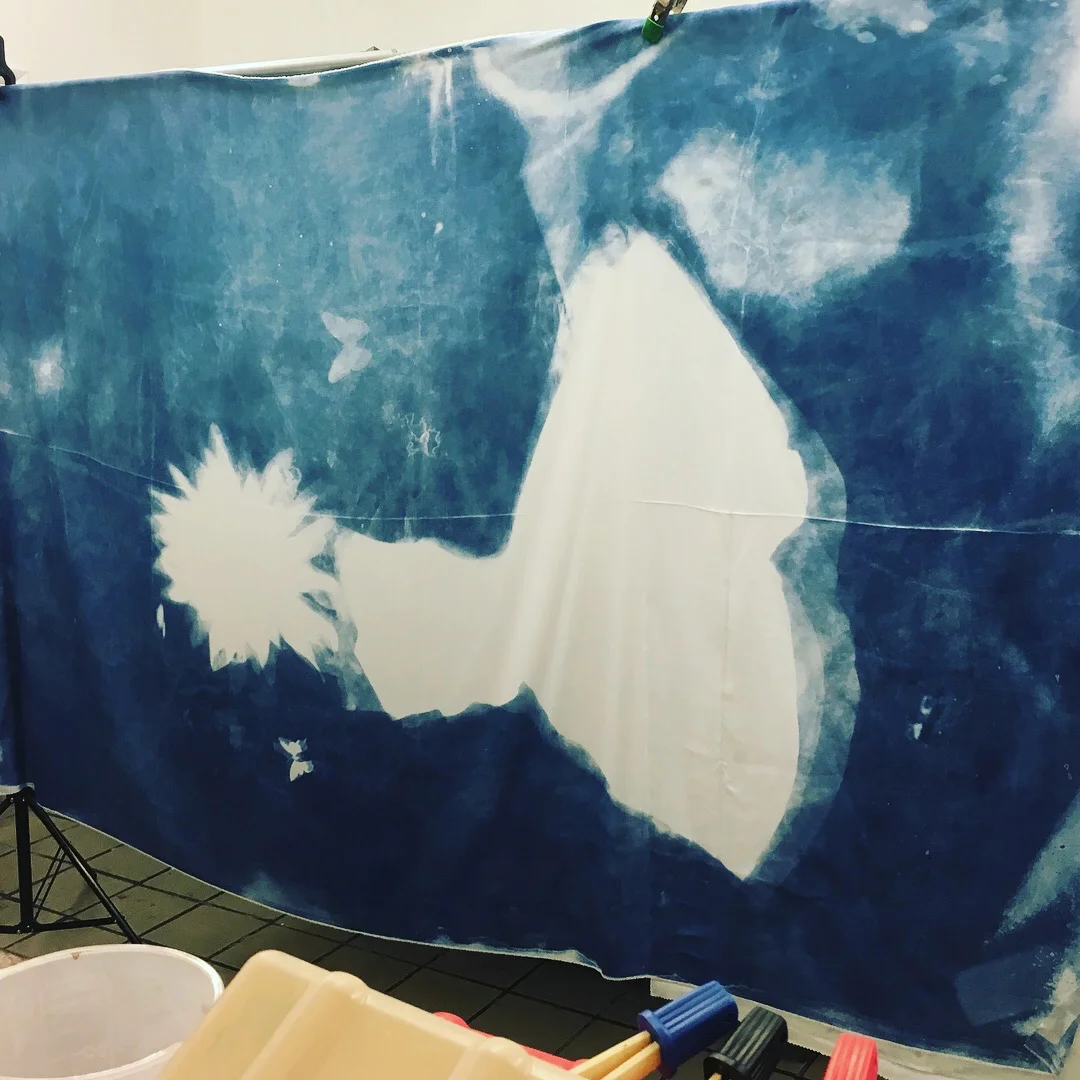
Cyanotype is the perfect photographic medium for murals. It is easily applied to many different kinds of surfaces, affordable to use in large quantities, and can be exposed in the sun and developed with water. In this mini-workshop you will learn the basics of image-making on light-sensitive surfaces and how to work on a large scale in terms of composition and maneuvering large cloth.
Invented in 1843, cyanotype is a chemical photographic process that is only sensitive to UV light and is famous for its blue color. Students will each work on a large section of cloth (roughly 5x8 feet) to create a mural composition in cyanotype. We will utilize the photogram technique which uses objects to block light from a light-sensitive surface, creating a 1:1 ratio between the object and the final image. For example, if you use your body and lay on the light-sensitive cloth your final image will be the exact shape of your body. You will need to bring your own objects for photograms (and they can be big!). This class is weather dependent as exposures for the cyanotype mural will be done outside and it will be rescheduled if needed.

This session has passed. Join our mailing list to receive news on current and future workshops.
Liquid Light is a silver-gelatin liquid emulsion that can be painted onto paper, cloth, stone, wood, and other substrates. If applied correctly, photographs can be printed onto the substrate with an enlarger or through contact printing. In this mini-workshop you will learn how to prepare a tile for Liquid Light emulsion and print onto it. The print can be a photogram (using an object as the negative) or from digital negatives of digital images. You are encouraged to bring your own objects for photograms. If you would like to use a digital image for a nominal fee, you can email us your image prior to the class so we can have it ready to go.
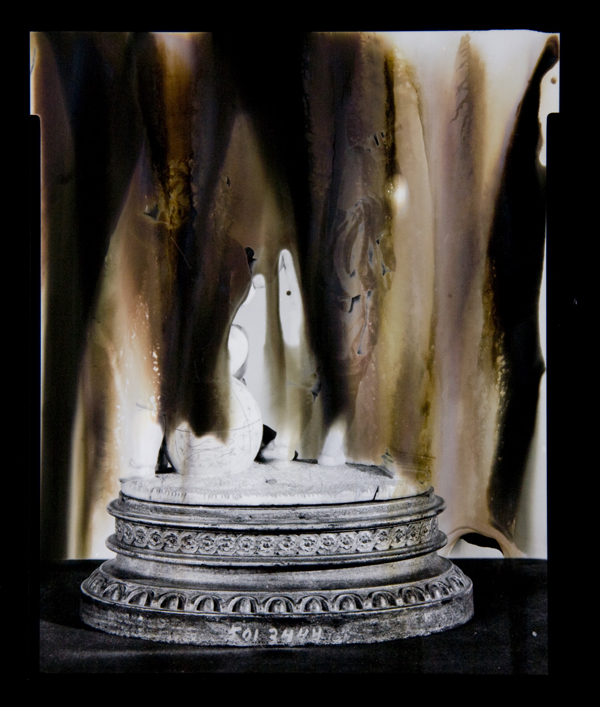
This session has passed. Join our mailing list to receive news on current and future workshops.
This relatively new process (introduced in 1991) is great for exploring the limits of gelatin silver printing. This workshop will introduce basic gelatin silver printing using digital negatives, discuss the principles and chemistry underlying the chromo process, and allow for hands-on printing time to explore the technique. The chemicals primarily affect the white portions of an image so a high-contrast photo with white space will work best. Students are encouraged to submit 2 images for digital negatives or to use the photogram technique.

Platinum palladium printing is a 19th century photographic process known for an extended tonal range that results in beautiful transitions from highlights to shadows. It is a classic and timeless aesthetic that is also prized for its archival quality because the noble metals platinum and palladium are used in the light-sensitive chemical solution that is the basis of the image. In this class you will learn the basics of this process combined with 21st century digital imaging which allows us to make handmade platinum palladium prints from your digital photos.
This workshop is for beginners new to platinum palladium as well as those with some experience who want to boost their knowledge of the process or try calibrated digital negatives for the first time. We will walk you through the process—from converting your digital photo to a physical large-format negative (i.e. a digital negative), to mixing your chemical solution of platinum and palladium, to hand-coating paper, to UV exposure, to using different types of developers to produce warm and neutral tones in your final print. Students must bring digital images to make calibrated digital negatives which make platinum palladium printing easier than ever.
We believe in hands-on learning and we will get you started immediately in printing your own images so that you leave the workshop with a strong foundation in the process as well as with multiple prints. It is important to note that platinum and palladium metals are quite expensive which dictates the cost of this workshop.
About the Instructor
David Hyams is an artist and educator with over 2 decades of experience in historical photographic processes and darkroom techniques. He managed the darkroom and designed workshops for Bostick & Sullivan, contributed to research for Christoper James’ “Book of Alternative Processes,” and is a consultant and master printer for a variety of artists. David is the co-founder of Luminaria, an alternative photography studio in Salt Lake City, Utah that offers group and custom workshops, master printing in a wide range of photographic processes, and one-of-a-kind tintype portraiture.

This session has passed. Join our mailing list to receive news on current and future workshops.
A pinhole camera is a light-tight box with a pinhole for a lens. It takes unique photographs that are dreamy and imperfect. In this mini-workshop you will make a pinhole camera and use it to shoot gelatin silver negatives in our studio or around the neighborhood. We will provide basic camera materials but you are encouraged to bring your own object to turn into a pinhole camera.

This session has passed. Join our mailing list to receive news on current and future workshops.
Instead of negatives, photograms use objects to block light from a light-sensitive emulsion. They are simple, design-oriented images that can be as minimal or ornate as you like. In this mini-workshop we will use cyanotype and gelatin silver paper to make photograms with found objects, pressed-plants, and our bodies. You are encouraged to bring your own objects for photograms.

December 1, 2018, 1-4pm
$50/person
Ditch the generic card and make something unique this holiday season. Invented in 1843, cyanotype is a chemical photographic process that is only sensitive to UV light and is famous for its blue color. It is perfect for beginners as it is also one of the cheapest and most user-friendly of the chemical photographic processes. In this mini-workshop we will use cyanotype to print photographs or make photograms (a term for using objects as negatives) to send as holiday cards. Bring a friend or come solo so you can send all your loved ones something to surprise them with your amazing artistic abilities!
Workshops have no minimum of enrollment requirement but the maximum is 6 students. Crafternoons are non-refundable though we will work with you to reschedule when possible.

This session has passed. Join our mailing list to receive news on current and future workshops.
This workshop will build on a basic knowledge of alternative printing with an in-depth introduction to palladium printing. We will explore the process from capture to print including digital photography, digital negative workflow, paper options, paper coating, exposure, and how to choose the proper chemistry for your desired final aesthetic. Finally we will discuss finishing techniques and where to source the various materials necessary to continue making palladium prints in your home studio.
Weekend Workshops require no minimum of enrollment but the maximum is 6 students. We will refund 80% of the fee if you cancel 3 weeks prior to the first day of the workshop. We will refund 50% of the fee if you cancel 1 week prior to the first day of enrollment. No refunds will be issued with less than 1 week notice of cancellation.

This session has passed. Join our mailing list to receive news on current and future workshops.
Great Salt Lake is often overlooked by Salt Lakers, but it is one of the most beautiful and interesting places in Utah. For this Photo Safari we will spend an evening at the shore near Black Rock, Great Salt Lake Marina State Park, and Saltair (about a 15 minute drive from Luminaria) on Day 1. On Day 2, we will make digital negatives from our digital images and print them in cyanotype —one of the earliest photographic processes to be invented and famous for its blue color. Digital cameras are required as there will not be enough time to develop film. Cell phone cameras are welcome and work really well on Safari.
Workshops have no minimum of enrollment requirement but the maximum is 6 students. Photo Safaris are non-refundable though we will work with you to reschedule when possible.

This session has passed. Join our mailing list to receive news on current and future workshops.
July is a fabulous time to explore the Wasatch Front and photograph everything from wildflowers to vistas. Day 1 will include a short tutorial on the properties of cyanotype and how to photograph to maximize those properties before we caravan to the Avenues Twin Peaks trailhead. Day 2 will primarily be in the studio printing digital negatives, coating paper, and making cyanotypes from the previous day’s safari. Digital cameras are preferred as there will be no time to develop film. Cell phone cameras are not discouraged.
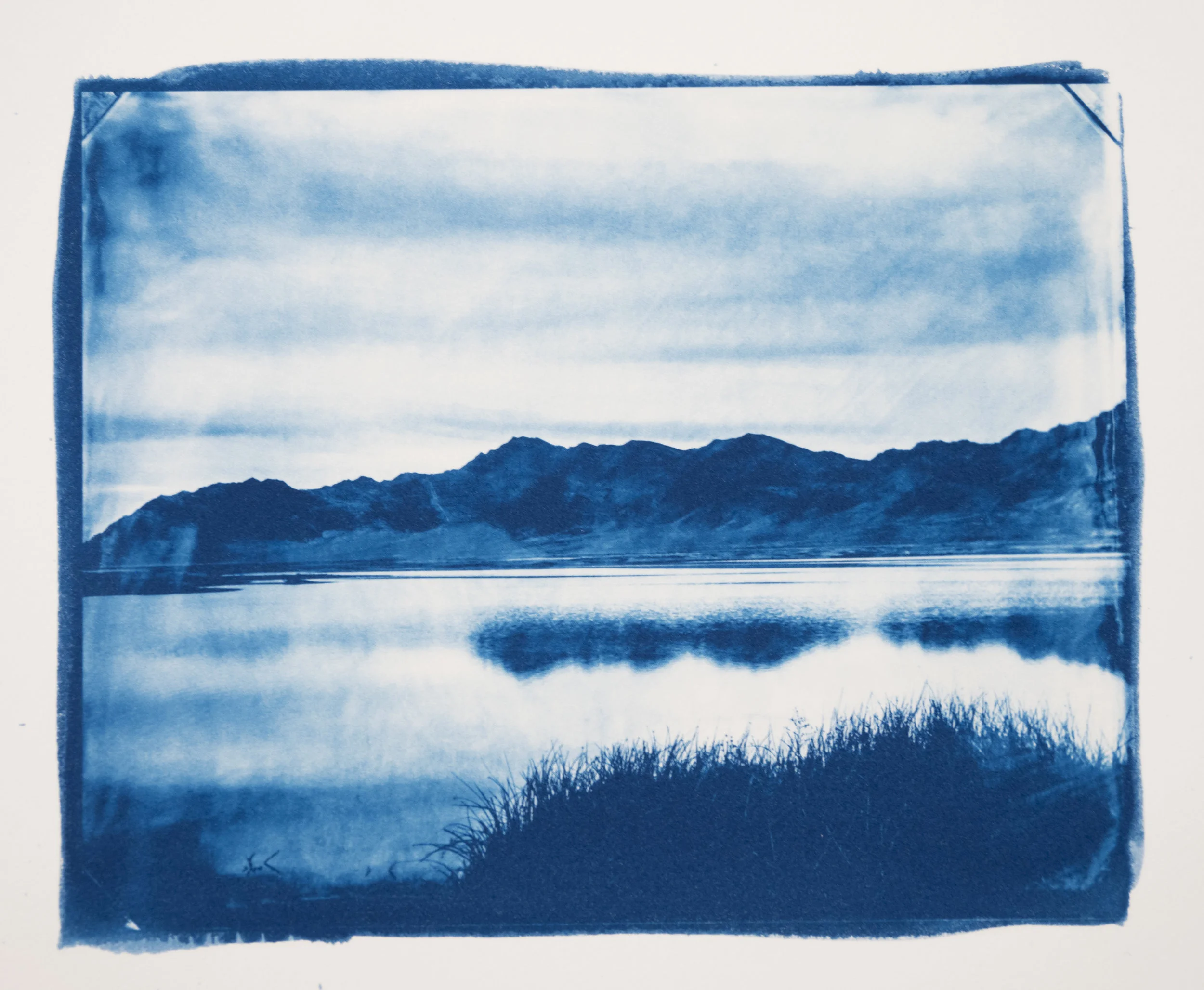
This session has passed. Join our mailing list to receive news on current and future workshops.
This introduction to alternative processes touches on the basic techniques of contact printing, digital negatives, UV exposures, and hand-coated emulsions. Students will work with cyanotype, Van Dyke Brown, and Kallitype to learn basic skills and form the basis for future classes focused on one medium.

This session has passed. Join our mailing list to receive news on current and future workshops.
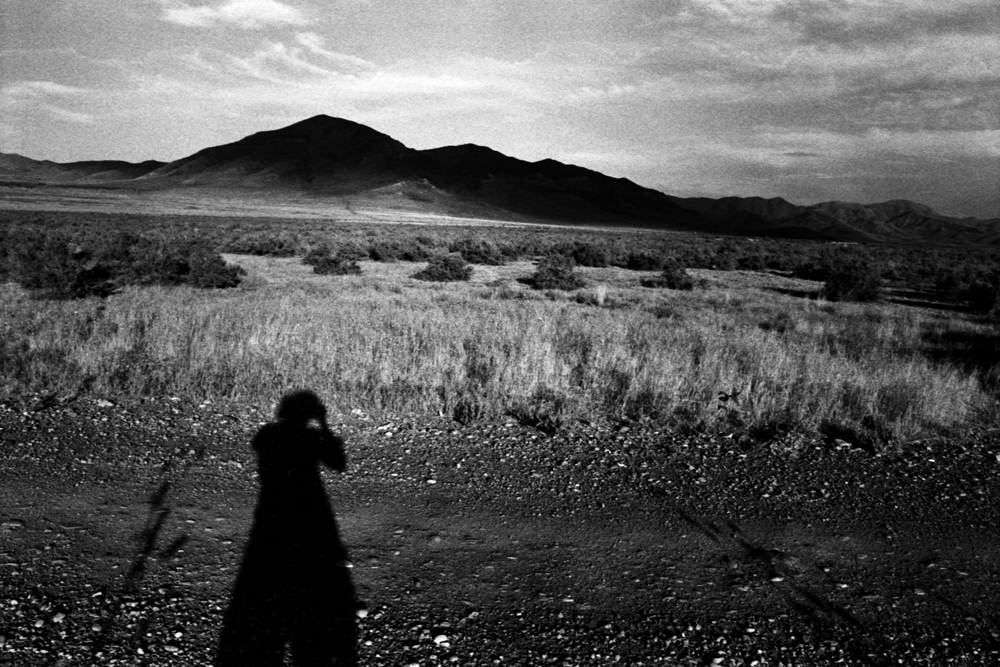
Have you been practicing wet plate but have technical questions or need guidance on how to perfect or control the chemical process? Or, do you have a wet plate project in mind and need some instruction to realize it? Then this is the class for you. We will focus on expanding your collodion skill set, from creating stained glass ambrotypes, collodion glass negatives for printing in alternative processes, or taking your collodion work to a larger size. We will focus on advanced trouble shooting and field techniques, and build a greater understanding of the chemistry that is working to create your images.
Saturday, November 23, 1-4pm
6 students max
$50
When you think of the important things you can’t live without, what comes to mind? Photographs of loved ones, life’s important events, and those silly moments we want to hold onto forever come to ours. With the holidays around the corner, this is your opportunity to make these memories tangible as gelatin silver mini-prints. Join us for an afternoon in the darkroom making classic black and white photographs that will last a lifetime. Participants will make 4 5x7 prints of their own digital images utilizing our calibrated digital negatives and gelatin silver photographic paper. Experience darkroom printing and the magic of an image appearing before your eyes in this Crafernoon!
Participants will make their prints using the contact-printing technique and calibrated digital negatives. This allows us to print any digital file as a traditional gelatin silver print instead of using film. Gelatin silver printing utilizes commercially-produced light-sensitive paper with a classic black and white aesthetic. This mini-workshop is for anyone new to chemical photography and those interested in learning a new technique for making gelatin silver prints.
This session has passed. Join our mailing list to receive news on current and future workshops.
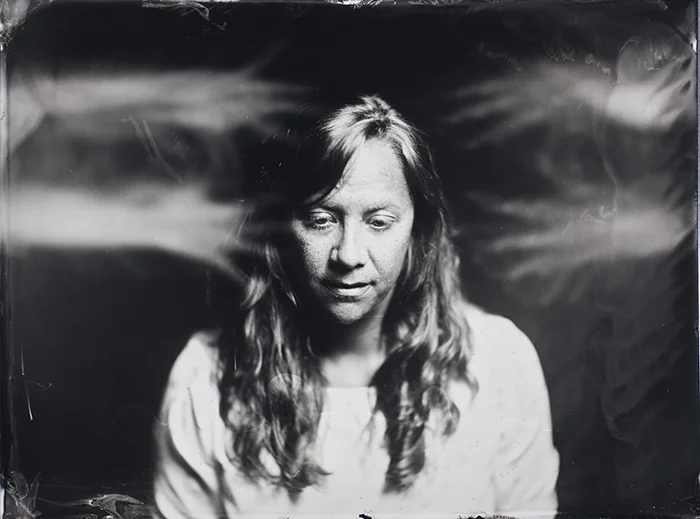
Have you ever seen an unexplained figure in a photograph? Photography has a long history of use to capture ghosts and things the human eye cannot see. For this two-day workshop, we will play with this idea and create spirit images using wet plate photographic techniques. Wet plate collodion was released to the public in 1851, and its vintage characteristics make it ideal for creating unique, ghostly images from the past. This workshop will focus mainly on tintype photography, where a unique positive is created in-camera on a sheet of blackened metal. You do not need any experience in wet plate photography for this class. However, we will primarily be focused on making spirit images and less on the mechanics and principles of the medium.
Workshops have no minimum of enrollment requirement but the maximum is 6 students. We will refund 80% of the fee if you cancel 3 weeks prior to the first day of the workshop and 50% if you cancel 1 week prior to the first day. No refunds will be issued with less than 7 days notice of cancellation.

This session has passed. Join our mailing list to receive news on current and future workshops.
Central 9th is an eclectic neighborhood full of character and home to Luminaria. Day 1 will include a short tutorial on the properties of cyanotype, how to photograph to maximize those properties, and time to explore the urban landscape. Day 2 will primarily be in the studio printing digital negatives, coating paper, and making cyanotypes from the previous day’s safari. Digital cameras are preferred as there will be no time to develop film. Cell phone cameras are not discouraged.

This session has passed. Join our mailing list to receive news on current and future workshops.
Many alternative processes are done with contact printing and not negative enlargement. Prior to digital negatives, cumbersome and expensive medium and large-format cameras shot large negatives. At Luminaria we combine digital and darkroom techniques to design digital negatives for the process you want to print. In this class you will learn the basic principles for calibrating negatives for any process you like.

This session has passed. Join our mailing list to receive news on current and future workshops.
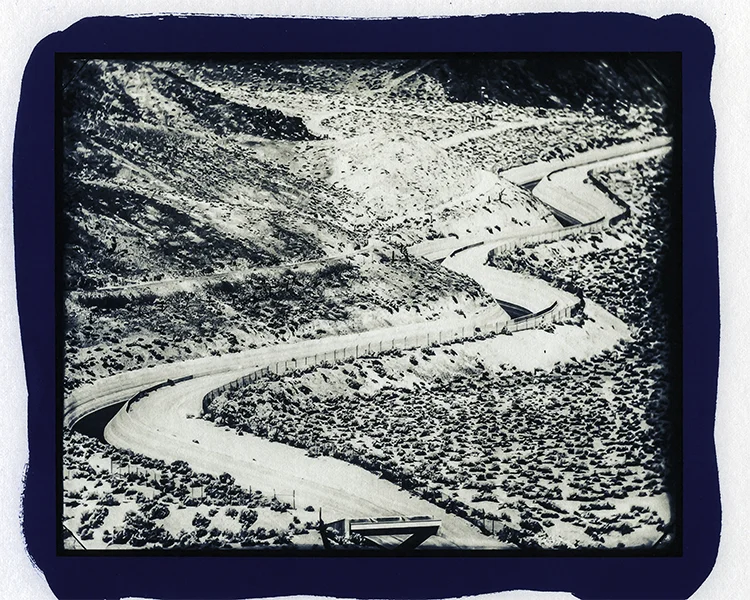
Wet plate is very technical and we suggest taking an intro class to learn the basics instead of trying it on your own. Using Holga cameras you will learn the basics for flowing, sensitizing, shooting, developing, and fixing plates. This is a wonderful introduction that aims to keep costs low, avoid frustration, and prepare you for independent work and/or an intermediate workshop.
*Price of Holga not included
This session has passed. Join our mailing list to receive news on current and future workshops.
Digital negatives can be tailored to the process you want to print. When combining processes you can tailor your negative to the parts of the image you wish to be in one process versus another. In this class you will build upon a basic knowledge of digital negatives to learn how to reverse engineer a print and tailor your negatives to the desired outcome.

This session has passed. Join our mailing list to receive news on current and future workshops.
Platinum palladium printing can be intimidating and expensive to learn, but at Luminaria we break down the steps so you waste as little as possible and build confidence. You will learn the basics of hand-coating paper, contact printing, exposing, developing, and washing these remarkable prints. Digital negatives will be used and students are encouraged to bring digital images to print.

This session has passed. Join our mailing list to receive news on current and future workshops.
Make your special someone a handmade token of your love using cyanotype. Cyanotype is a chemical process that is sensitive to UV light and creates prints in blue tones (it is also called a blue print). In this Crafternoon you will make paper cards with cyanotype images that can utilize the photogram technique (using an object as the negative), or make a digital negative of one of your own digital images. You are encouraged to bring your own objects for photograms. If you would like to use a digital image for an additional nominal fee, you can email us your image prior to the class so we can have it ready to go.
Workshops have no minimum of enrollment requirement but the maximum is 6 students. Crafternoons are non-refundable though we will work with you to reschedule when possible.

This session has passed. Join our mailing list to receive news on current and future workshops.
Platinum palladium printing can be intimidating and expensive to learn, but at Luminaria we use calibrated digital negatives so you waste as little as possible and build confidence. In this mini-workshop students will make 2 5x7 inch images from digital files of their choosing to learn the basics of hand-coating paper, contact printing, exposing, developing, and washing these remarkable prints. This session is designed to be an affordable introduction allowing the student to experience how easy platinum palladium printing can be when using calibrated digital negatives.
Workshops have no minimum of enrollment requirement but the maximum is 10 students. We will refund 80% of the fee if you cancel 3 weeks prior to the first day of the workshop and 50% if you cancel 1 week prior to the first day. No refunds will be issued with less than 7 days notice of cancellation.

May 11-12, 2019
$100/person
Located at 749 East 500 South in Salt Lake City, Gilgal Sculpture Garden was created by Thomas Battersby Child, Jr. in the mid-twentieth century and is comprised of 12 sculptures and 70 stone engravings. For this Photo Safari we will spend half a day on Day 1 (afternoon to early evening) at Gilgal Garden exploring the various imagery and photographing. On Day 2 (10am-3pm) we will make digital negatives from our digital images and print them in cyanotype —one of the earliest photographic processes to be invented and famous for its blue color. Digital cameras are required as there will not be enough time to develop film. Cell phone cameras are welcome and work really well on Safari.
Workshops have no minimum of enrollment requirement but the maximum is 6 students. Photo Safaris are non-refundable though we will work with you to reschedule when possible.

This session has passed. Join our mailing list to receive news on current and future workshops.
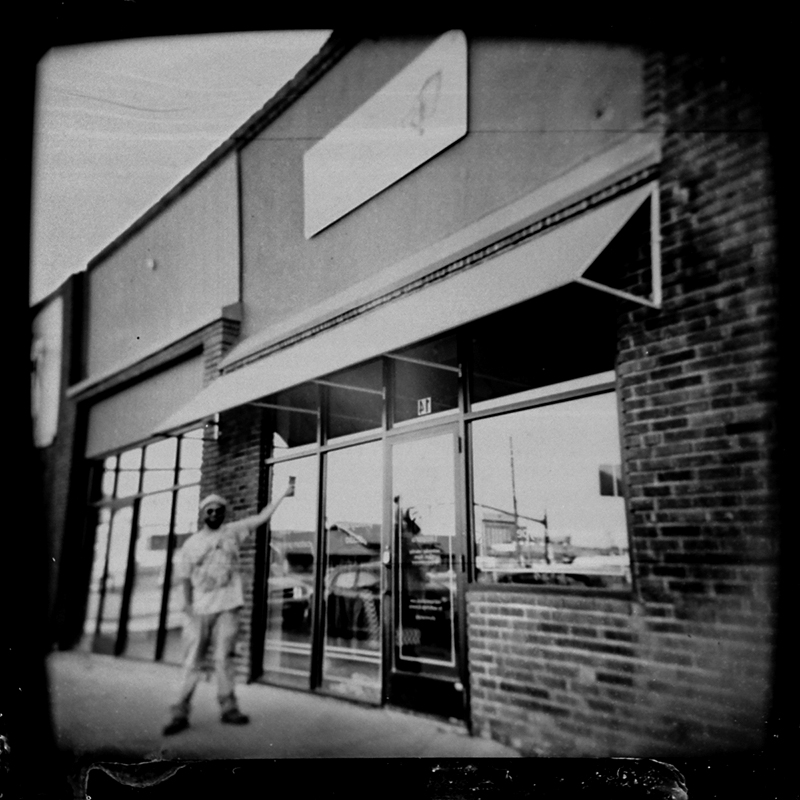
Join us for 3 days of investigation into processes that use silver and salt to create beautiful handmade photographic images. Salted paper & albumen printing are some of the earliest photographic processes, and when combined with an array of toning options can cover a wide range of asthetics. We will create hand made prints for 3 days and explore the many creative options that are available from these silver based historic processes.
February 23-24, 2019, 10am-5pm
$500/person
Wet plate collodion was invented by Frederick Scott Archer in 1851. When used on a tin plate (called a tintype), the image is an in-camera positive that is one-of-a-kind. It is a very technical process that utilizes expensive and dangerous chemicals. This workshop is an introduction using affordable Holga cameras to learn the basics of flowing, sensitizing, shooting, developing, and fixing plates. This is a fun introduction that aims to keep costs low, avoid frustration, and prepare you for independent work and/or an intermediate workshop.
Workshops have no minimum of enrollment requirement but the maximum is 4 students. We will refund 80% of the fee if you cancel 3 weeks prior to the first day of the workshop and 50% if you cancel 1 week prior to the first day. No refunds will be issued with less than 7 days notice of cancellation.
Platinum palladium printing is a 19th century photographic process known for an extended tonal range that results in beautiful transitions from highlights to shadows. It is a classic and timeless aesthetic that is also prized for its archival quality because the noble metals platinum and palladium are used in the light-sensitive chemical solution that is the basis of the image. In this class you will learn the basics of this process combined with 21st century digital imaging which allows us to make handmade platinum palladium prints from your digital photos.
This workshop is for beginners new to platinum palladium as well as those with some experience who want to boost their knowledge of the process or try calibrated digital negatives for the first time. We will walk you through the process—from converting your digital photo to a physical large-format negative (i.e. a digital negative), to mixing your chemical solution of platinum and palladium, to hand-coating paper, to UV exposure, to using different types of developers to produce warm and neutral tones in your final print. Students must bring digital images to make calibrated digital negatives which make platinum palladium printing easier than ever.
We believe in hands-on learning and we will get you started immediately in printing your own images so that you leave the workshop with a strong foundation in the process as well as with multiple prints. It is important to note that platinum and palladium metals are quite expensive which dictates the cost of this workshop.
About the Instructor
David Hyams is an artist and educator with over 2 decades of experience in historical photographic processes and darkroom techniques. He managed the darkroom and designed workshops for Bostick & Sullivan, contributed to research for Christoper James’ “Book of Alternative Processes,” and is a consultant and master printer for a variety of artists. David is the co-founder of Luminaria, an alternative photography studio in Salt Lake City, Utah that offers group and custom workshops, master printing in a wide range of photographic processes, and one-of-a-kind tintype portraiture.

April 6-7, 2019, 10am-5pm
$100/person
The Utah State Capitol is a neoclassical revival, Corinthian-style building designed by architect Richard K.A. Kletting and built between 1912 and 1916. The interior features incredible architectural details and art while the grounds feature historical markers, Yoshino cherry trees, and an expansive view of Salt Lake City. For this Photo Safari we will spend Day 1 at the capitol exploring the grounds and photographing. On Day 2 we will make digital negatives from our digital images and print them in cyanotype —one of the earliest photographic processes to be invented and famous for its blue color. Digital cameras are required as there will not be enough time to develop film. Cell phone cameras are welcome and work really well on Safari.
Workshops have no minimum of enrollment requirement but the maximum is 6 students. Photo Safaris are non-refundable though we will work with you to reschedule when possible.